71. Reading in a Whole New Way
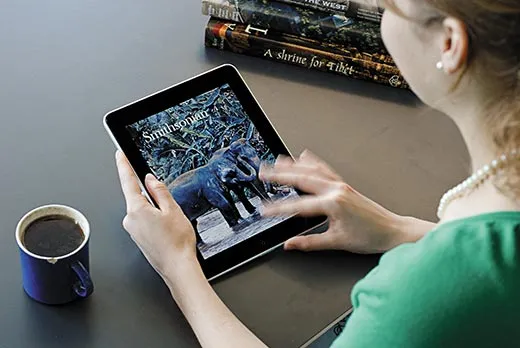
/https://tf-cmsv2-smithsonianmag-media.s3.amazonaws.com/filer/iPad-with-Smithsonian-first-cover-631.jpg)
America was founded on the written word. Its roots spring from documents—the Constitution, the Declaration of Independence and, indirectly, the Bible. The country'southward success depended on high levels of literacy, liberty of the press, allegiance to the rule of police force (found in books) and a common language across a continent. American prosperity and liberty grew out of a culture of reading and writing.
Only reading and writing, similar all technologies, are dynamic. In ancient times, authors often dictated their books. Dictation sounded like an uninterrupted series of letters, and then scribes wrote downwards the letters in i long continuous cord, justastheyoccurinspeech. Text was written without spaces between words until the 11th century. This continuous script made books hard to read, so only a few people were accomplished at reading them aloud to others. Being able to read silently to yourself was considered an astonishing talent. Writing was an even rarer skill. In 15th-century Europe merely one in 20 adult males could write.
After Gutenberg'southward printing press came forth around 1440, mass-produced books changed the way people read and wrote. The engineering of printing expanded the number of words available (from about 50,000 words in Old English to a million today). More word choices enlarged what could be communicated. More than media choices broadened what was written most. Authors did not take to compose scholarly tomes but could "waste" inexpensive books on heart-rending love stories (the romance novel was invented in 1740), or publish memoirs fifty-fifty if they were non kings. People could write tracts to oppose the prevailing consensus, and with cheap press those unorthodox ideas could gain enough influence to topple a king, or a pope. In fourth dimension, the power of authors birthed the idea of authority and bred a civilization of expertise. Perfection was achieved "by the volume." Laws were compiled into official tomes, contracts were written down and zip was valid unless put into words. Painting, music, architecture, trip the light fantastic toe were all important, but the heartbeat of Western civilisation was the turning pages of a book. By 1910 iii-quarters of the towns in America with more than 2,500 residents had a public library. We became a people of the book.
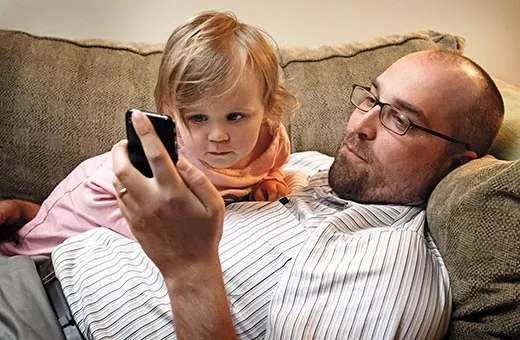
Today some 4.five billion digital screens illuminate our lives. Words take migrated from wood pulp to pixels on computers, phones, laptops, game consoles, televisions, billboards and tablets. Letters are no longer stock-still in black ink on paper, simply flitter on a drinking glass surface in a rainbow of colors as fast every bit our eyes tin can blink. Screens fill our pockets, briefcases, dashboards, living room walls and the sides of buildings. They sit down in front of us when we piece of work—regardless of what we exercise. We are now people of the screen. And of course, these newly ubiquitous screens have changed how we read and write.
The kickoff screens that overtook culture, several decades ago—the big, fat, warm tubes of television—reduced the fourth dimension nosotros spent reading to such an extent that it seemed equally if reading and writing were over. Educators, intellectuals, politicians and parents worried deeply that the Idiot box generation would be unable to write. Merely the interconnected cool, thin displays of the 2d moving ridge of screens launched an epidemic of writing that continues to peachy. The amount of time people spend reading has nigh tripled since 1980. By 2008 more than a trillion pages were added to the World Broad Web, and that total grows past several billion a day. Each of these pages was written by somebody. Right at present ordinary citizens compose 1.5 million blog posts per twenty-four hours. Using their thumbs instead of pens, young people in college or at work around the world collectively write 12 billion quips per day from their phones. More screens go on to keen the book of reading and writing.
But it is not book reading. Or newspaper reading. It is screen reading. Screens are always on, and, unlike with books nosotros never end staring at them. This new platform is very visual, and information technology is gradually merging words with moving images: words zip around, they float over images, serving every bit footnotes or annotations, linking to other words or images. Y'all might think of this new medium as books we picket, or television nosotros read. Screens are too intensely information-driven. Pixels encourage numeracy and produce rivers of numbers flowing into databases. Visualizing information is a new art, and reading charts a new literacy. Screen culture demands fluency in all kinds of symbols, not just messages.
And it demands more than our optics. The virtually physically active we may get while reading a book is to flip the pages or dog-ear a corner. But screens engage our bodies. Impact screens answer to the ceaseless cuddle of our fingers. Sensors in game consoles such as the Nintendo Wii track our easily and arms. We interact with what we see. Soon plenty, screens will follow our eyes to perceive where we gaze. A screen will know what we are paying attention to and for how long. In the futuristic movie Minority Written report (2002), the character played by Tom Cruise stands in front of a wraparound screen and hunts through vast athenaeum of data with the gestures of a symphony conductor. Reading becomes almost athletic. Just equally information technology seemed weird five centuries ago to see someone read silently, in the future information technology will seem weird to read without moving your trunk.
Books were good at developing a wistful mind. Screens encourage more than utilitarian thinking. A new idea or unfamiliar fact will provoke a reflex to exercise something: to research the term, to query your screen "friends" for their opinions, to observe alternative views, to create a bookmark, to interact with or tweet the thing rather than simply contemplate it. Volume reading strengthened our analytical skills, encouraging us to pursue an observation all the manner down to the footnote. Screen reading encourages rapid blueprint-making, associating this thought with another, equipping us to deal with the thousands of new thoughts expressed every day. The screen rewards, and nurtures, thinking in real time. We review a movie while we picket it, we come upward with an obscure fact in the middle of an argument, we read the possessor's manual of a gadget we spy in a shop before nosotros buy it rather than later on we get domicile and observe that information technology can't practice what we need information technology to exercise.
Screens provoke activeness instead of persuasion. Propaganda is less effective in a world of screens, because while misinformation travels fast, corrections do, likewise. On a screen it is oft easier to correct a falsehood than to tell ane in the starting time place; Wikipedia works so well because it removes an error in a single click. In books nosotros find a revealed truth; on the screen nosotros get together our ain truth from pieces. On networked screens everything is linked to everything else. The status of a new creation is adamant not past the rating given to it by critics just by the degree to which it is linked to the rest of the world. A person, artifact or fact does not "exist" until it is linked.
A screen can reveal the inner nature of things. Waving the camera heart of a smartphone over the bar lawmaking of a manufactured production reveals its cost, origins and fifty-fifty relevant comments by other owners. It is as if the screen displays the object's intangible essence. A popular kid's toy (Webkinz) instills stuffed animals with a virtual grapheme that is "hidden" within; a screen enables children to play with this inner character online in a virtual world.
Every bit portable screens become more powerful, lighter and larger, they will exist used to view more than of this inner globe. Hold an electronic tablet upwards every bit you walk along a street, and it will show an annotated overlay of the real street alee—where the clean restrooms are, which stores sell your favorite items, where your friends are hanging out. Computer chips are becoming so small, and screens and then sparse and inexpensive, that in the side by side 40 years semitransparent eyeglasses will apply an informational layer to reality. If you pick upwardly an object while peering through these spectacles, the object's (or place's) essential information will appear in overlay text. In this fashion screens will enable usa to "read" everything, not merely text. Last year solitary, 5 quintillion (x to the ability of xviii) transistors were embedded into objects other than computers. Very presently near manufactured items, from shoes to cans of soup, will contain a small sliver of dim intelligence, and screens will be the tool we utilise to interact with this transistorized information.
More important, our screens will as well lookout united states of america. They will be our mirrors, the wells into which we look to discover out about ourselves. Not to meet our confront, only our status. Already millions of people use pocketable screens to input their location, what they eat, how much they weigh, their mood, their slumber patterns and what they see. A few pioneers have begun lifelogging: recording every single detail, conversation, motion picture and activeness. A screen both records and displays this database of activities. The result of this abiding self-tracking is an impeccable "retention" of their lives and an unexpectedly objective and quantifiable view of themselves, i that no book can provide. The screen becomes function of our identity.
We live on screens of all sizes—from the IMAX to the iPhone. In the near future we will never be far from one. Screens will be the first place we'll look for answers, for friends, for news, for pregnant, for our sense of who we are and who we can be.
Kevin Kelly's book What Engineering science Wants volition exist published in October.
Source: https://www.smithsonianmag.com/science-nature/reading-in-a-whole-new-way-1144822/
0 Response to "71. Reading in a Whole New Way"
Post a Comment