Respond to "Learning to Read" From the Autobiography of Malcolm X Summary
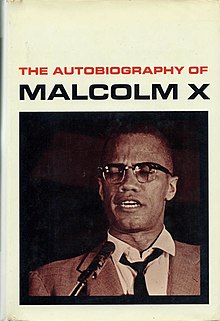 First edition | |
| Author | Malcolm X with Alex Haley |
|---|---|
| Country | United States |
| Linguistic communication | English language |
| Genre | Autobiography |
| Published | October 29, 1965 (Grove Press)[1] |
| OCLC | 219493184 |
The Autobiography of Malcolm X was published in 1965, the result of a collaboration betwixt human rights activist Malcolm X and journalist Alex Haley. Haley coauthored the autobiography based on a serial of in-depth interviews he conducted between 1963 and Malcolm Ten'south 1965 assassination. The Autobiography is a spiritual conversion narrative that outlines Malcolm X's philosophy of black pride, blackness nationalism, and pan-Africanism. After the leader was killed, Haley wrote the book's epilogue.[a] He described their collaborative process and the events at the end of Malcolm X'south life.
While Malcolm Ten and scholars contemporary to the volume'southward publication regarded Haley as the book'south ghostwriter, modern scholars tend to regard him every bit an essential collaborator who intentionally muted his authorial voice to create the effect of Malcolm X speaking directly to readers. Haley influenced some of Malcolm X'southward literary choices. For example, Malcolm 10 left the Nation of Islam during the period when he was working on the book with Haley. Rather than rewriting before chapters equally a polemic against the Nation which Malcolm X had rejected, Haley persuaded him to favor a manner of "suspense and drama". According to Manning Marable, "Haley was especially worried about what he viewed every bit Malcolm X's anti-Semitism" and he rewrote cloth to eliminate information technology.[ii]
When the Autobiography was published, The New York Times reviewer described it as a "brilliant, painful, important volume". In 1967, historian John William Ward wrote that it would get a classic American autobiography. In 1998, Time named The Autobiography of Malcolm Ten every bit ane of ten "required reading" nonfiction books.[3] James Baldwin and Arnold Perl adapted the book as a moving-picture show; their screenplay provided the source cloth for Spike Lee's 1992 film Malcolm 10.
Summary [edit]
Published posthumously, The Autobiography of Malcolm Ten is an account of the life of Malcolm X, born Malcolm Piffling (1925–1965), who became a human rights activist. Beginning with his mother's pregnancy, the book describes Malcolm'south childhood commencement in Omaha, Nebraska and and then in the area around Lansing and Mason, Michigan, the expiry of his male parent under questionable circumstances, and his mother's deteriorating mental health that resulted in her commitment to a psychiatric infirmary.[4] Petty'south young adulthood in Boston and New York City is covered, as well as his involvement in organized offense. This led to his arrest and subsequent 8- to 10-year prison house sentence, of which he served six-and-a-half years (1946–1952).[5] The book addresses his ministry building with Elijah Muhammad and the Nation of Islam (1952–1963) and his emergence as the organization's national spokesman. Information technology documents his disillusionment with and departure from the Nation of Islam in March 1964, his pilgrimage to Mecca, which catalyzed his conversion to orthodox Sunni Islam, and his travels in Africa.[6] Malcolm X was assassinated in New York'due south Audubon Ballroom in February 1965, earlier they finished the volume. His co-author, the announcer Alex Haley, summarizes the last days of Malcolm X's life, and describes in item their working agreement, including Haley'south personal views on his discipline, in the Autobiography 'southward epilogue.[seven]
Genre [edit]
The Autobiography is a spiritual conversion narrative that outlines Malcolm X'south philosophy of black pride, black nationalism, and pan-Africanism.[8] Literary critic Arnold Rampersad and Malcolm X biographer Michael Eric Dyson concur that the narrative of the Autobiography resembles the Augustinian arroyo to confessional narrative. Augustine's Confessions and The Autobiography of Malcolm 10 both chronicle the early hedonistic lives of their subjects, certificate deep philosophical change for spiritual reasons, and draw later disillusionment with religious groups their subjects had once revered.[nine] Haley and autobiographical scholar Albert E. Rock compare the narrative to the Icarus myth.[10] Author Paul John Eakin and author Alex Gillespie suggest that office of the Autobiography 'due south rhetorical power comes from "the vision of a man whose swiftly unfolding career had outstripped the possibilities of the traditional autobiography he had meant to write",[11] thus destroying "the illusion of the finished and unified personality".[12]
In addition to functioning as a spiritual conversion narrative, The Autobiography of Malcolm Ten likewise reflects generic elements from other distinctly American literary forms, from the Puritan conversion narrative of Jonathan Edwards and the secular self-analyses of Benjamin Franklin, to the African American slave narratives.[thirteen] This aesthetic determination on the part of Malcolm X and Haley also has profound implications for the thematic content of the work, as the progressive move between forms that is evidenced in the text reflects the personal progression of its subject. Because this, the editors of the Norton Anthology of African American Literature assert that, "Malcolm's Autobiography takes pains to interrogate the very models through which his persona achieves gradual self-understanding...his story's inner logic defines his life equally a quest for an authentic mode of being, a quest that demands a constant openness to new ideas requiring fresh kinds of expression."[14]
Construction [edit]
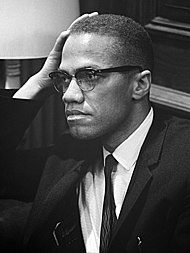
Malcolm X waiting for a press briefing to brainstorm on March 26, 1964
Haley coauthored The Autobiography of Malcolm X, and besides performed the basic functions of a ghostwriter and biographical agent,[fifteen] writing, compiling, and editing[16] the Autobiography based on more than 50 in-depth interviews he conducted with Malcolm Ten between 1963 and his subject's 1965 bump-off.[17] The two showtime met in 1959, when Haley wrote an article about the Nation of Islam for Reader's Digest, and once again when Haley interviewed Malcolm X for Playboy in 1962.[18]
In 1963 the Doubleday publishing company asked Haley to write a book about the life of Malcolm X. American writer and literary critic Harold Bloom writes, "When Haley approached Malcolm with the idea, Malcolm gave him a startled await ..."[19] Haley recalls, "It was i of the few times I have ever seen him uncertain."[19] After Malcolm Ten was granted permission from Elijah Muhammad, he and Haley commenced work on the Autobiography, a process which began as two-and three-60 minutes interview sessions at Haley's studio in Greenwich Hamlet.[19] Bloom writes, "Malcolm was disquisitional of Haley'southward heart-class status, equally well as his Christian beliefs and twenty years of service in the U.Due south. Military."[xix]
When work on the Autobiography began in early 1963, Haley grew frustrated with Malcolm X's tendency to speak only near Elijah Muhammad and the Nation of Islam. Haley reminded him that the book was supposed to be about Malcolm Ten, not Muhammad or the Nation of Islam, a comment which angered Malcolm Ten. Haley eventually shifted the focus of the interviews toward the life of his subject area when he asked Malcolm Ten about his mother:[20]
I said, 'Mr. Malcolm, could y'all tell me something about your mother?' And I will never, ever forget how he stopped almost as if he was suspended like a marionette. And he said, 'I call up the kind of dresses she used to wearable. They were old and faded and grayness.' And then he walked some more. And he said, 'I remember how she was e'er bent over the stove, trying to stretch what little we had.' And that was the beginning, that night, of his walk. And he walked that flooring until only about daybreak.[21]
Though Haley is ostensibly a ghostwriter on the Autobiography, modern scholars tend to treat him every bit an essential and core collaborator who acted as an invisible figure in the composition of the work.[22] He minimized his own voice, and signed a contract to limit his authorial discretion in favor of producing what looked like verbatim copy.[23] Manning Marable considers the view of Haley equally only a ghostwriter as a deliberate narrative construction of black scholars of the day who wanted to see the book every bit a singular cosmos of a dynamic leader and martyr.[24] Marable argues that a critical analysis of the Autobiography, or the full relationship betwixt Malcolm 10 and Haley, does non support this view; he describes it instead as a collaboration.[25]
Haley'due south contribution to the work is notable, and several scholars discuss how it should be characterized.[26] In a view shared by Eakin, Stone and Dyson, psychobiographical writer Eugene Victor Wolfenstein writes that Haley performed the duties of a quasi-psychoanalytic Freudian psychiatrist and spiritual confessor.[27] [28] Gillespie suggests, and Wolfenstein agrees, that the human activity of self-narration was itself a transformative procedure that spurred pregnant introspection and personal change in the life of its subject.[29]
Haley exercised discretion over content,[30] guided Malcolm X in critical stylistic and rhetorical choices,[31] and compiled the piece of work.[32] In the epilogue to the Autobiography, Haley describes an agreement he made with Malcolm X, who demanded that: "Null can exist in this book's manuscript that I didn't say and nothing can exist left out that I want in information technology."[33] Equally such, Haley wrote an addendum to the contract specifically referring to the book as an "every bit told to" account.[33] In the agreement, Haley gained an "important concession": "I asked for—and he gave—his permission that at the end of the book I could write comments of my own about him which would not be bailiwick to his review."[33] These comments became the epilogue to the Autobiography, which Haley wrote after the death of his subject.[34]
Narrative presentation [edit]
In "Malcolm X: The Art of Autobiography", writer and professor John Edgar Wideman examines in detail the narrative landscapes found in biography. Wideman suggests that as a writer, Haley was attempting to satisfy "multiple allegiances": to his bailiwick, to his publisher, to his "editor'due south agenda", and to himself.[35] Haley was an important contributor to the Autobiography 's pop appeal, writes Wideman.[36] Wideman expounds upon the "inevitable compromise" of biographers,[35] and argues that in social club to allow readers to insert themselves into the broader socio-psychological narrative, neither coauthor's voice is as strong as information technology could have been.[37] Wideman details some of the specific pitfalls Haley encountered while coauthoring the Autobiography:
You are serving many masters, and inevitably you are compromised. The man speaks and you listen but yous exercise not take notes, the showtime compromise and perhaps betrayal. Y'all may attempt through diverse stylistic conventions and devices to reconstitute for the reader your experience of hearing face up to face the man's words. The audio of the man'southward narration may be represented by vocabulary, syntax, imagery, graphic devices of diverse sorts—quotation marks, punctuation, line breaks, visual patterning of white space and black space, markers that encode print analogs to speech—colloquial interjections, parentheses, ellipses, asterisks, footnotes, italics, dashes ....[35]
In the body of the Autobiography, Wideman writes, Haley's authorial agency is seemingly absent-minded: "Haley does so much with and so lilliputian fuss ... an arroyo that appears so rudimentary in fact conceals sophisticated choices, quiet mastery of a medium".[34] Wideman argues that Haley wrote the body of the Autobiography in a way of Malcolm X's choosing and the epilogue as an extension of the biography itself, his bailiwick having given him carte blanche for the chapter. Haley's voice in the body of the book is a tactic, Wideman writes, producing a text nominally written by Malcolm X just seemingly written by no author.[35] The subsumption of Haley's ain voice in the narrative allows the reader to feel as though the voice of Malcolm X is speaking direct and continuously, a stylistic tactic that, in Wideman's view, was a matter of Haley'due south authorial choice: "Haley grants Malcolm the tyrannical authority of an author, a disembodied speaker whose unsaid presence blends into the reader'southward imagining of the tale being told."[38]
In "Two Create I: The Act of Collaboration in Recent Blackness Autobiography: Ossie Guffy, Nate Shaw, and Malcolm X", Rock argues that Haley played an "essential role" in "recovering the historical identity" of Malcolm Ten.[39] Rock also reminds the reader that collaboration is a cooperative endeavor, requiring more than Haley's prose alone can provide, "disarming and coherent" as it may exist:[twoscore]
Though a author'south skill and imagination have combined words and voice into a more or less convincing and coherent narrative, the actual writer [Haley] has no big fund of memories to describe upon: the subject'due south [Malcolm X] memory and imagination are the original sources of the arranged story and have too come up into play critically as the text takes terminal shape. Thus where fabric comes from, and what has been washed to it are separable and of equal significance in collaborations.[41]
In Rock's estimation, supported by Wideman, the source of autobiographical material and the efforts made to shape them into a workable narrative are distinct, and of equal value in a critical assessment of the collaboration that produced the Autobiography.[42] While Haley's skills as writer have pregnant influence on the narrative's shape, Stone writes, they crave a "discipline possessed of a powerful retentiveness and imagination" to produce a workable narrative.[forty]
Collaboration betwixt Malcolm X and Haley [edit]
The collaboration betwixt Malcolm Ten and Haley took on many dimensions; editing, revising and composing the Autobiography was a ability struggle betwixt two men with sometimes competing ideas of the concluding shape for the book. Haley "took pains to show how Malcolm dominated their human relationship and tried to command the composition of the book", writes Rampersad.[43] Rampersad also writes that Haley was aware that retentiveness is selective and that autobiographies are "almost by definition projects in fiction", and that it was his responsibleness as biographer to select textile based on his authorial discretion.[43] The narrative shape crafted by Haley and Malcolm X is the consequence of a life account "distorted and macerated" by the "process of selection", Rampersad suggests, nevertheless the narrative's shape may in actuality be more revealing than the narrative itself.[44] In the epilogue Haley describes the process used to edit the manuscript, giving specific examples of how Malcolm X controlled the language.[45]
'You tin can't bless Allah!' he exclaimed, irresolute 'bless' to 'praise.' ... He scratched ruby through 'nosotros kids.' 'Kids are goats!' he exclaimed sharply.
Haley, describing work on the manuscript, quoting Malcolm X[45]
While Haley ultimately deferred to Malcolm X's specific choice of words when composing the manuscript,[45] Wideman writes, "the nature of writing biography or autobiography ... means that Haley's promise to Malcolm, his intent to be a 'dispassionate chronicler', is a thing of disguising, not removing, his authorial presence."[35] Haley played an of import part in persuading Malcolm X not to re-edit the book as a polemic against Elijah Muhammad and the Nation of Islam at a time when Haley already had most of the material needed to complete the volume, and asserted his authorial agency when the Autobiography 'southward "fractured construction",[46] caused past Malcolm X's rift with Elijah Muhammad and the Nation of Islam, "overturned the design"[47] of the manuscript and created a narrative crunch.[48] In the Autobiography 'due south epilogue, Haley describes the incident:
I sent Malcolm X some rough chapters to read. I was appalled when they were soon returned, red-inked in many places where he had told of his almost male parent-and-son relationship with Elijah Muhammad. Telephoning Malcolm X, I reminded him of his previous decisions, and I stressed that if those chapters contained such telegraphing to readers of what was to lie ahead, then the book would automatically be robbed of some of its building suspense and drama. Malcolm X said, gruffly, 'Whose volume is this?' I told him 'yours, of course,' and that I only made the objection in my position equally a writer. But late that night Malcolm X telephoned. 'I'm sorry. You're right. I was upset about something. Forget what I wanted changed, let what y'all already had stand.' I never again gave him capacity to review unless I was with him. Several times I would covertly spotter him frown and wince equally he read, but he never again asked for any modify in what he had originally said.[45]

Haley in the United States Coast Baby-sit, 1939
Haley'due south warning to avoid "telegraphing to readers" and his advice nearly "edifice suspense and drama" demonstrate his efforts to influence the narrative's content and affirm his authorial bureau while ultimately deferring final discretion to Malcolm Ten.[45] In the above passage Haley asserts his authorial presence, reminding his subject that as a writer he has concerns almost narrative direction and focus, only presenting himself in such a manner every bit to requite no doubtfulness that he deferred terminal blessing to his subject field.[49] In the words of Eakin, "Because this complex vision of his existence is clearly not that of the early sections of the Autobiography, Alex Haley and Malcolm 10 were forced to confront the consequences of this discontinuity in perspective for the narrative, already a year old."[50] Malcolm X, afterward giving the matter some thought, later on accepted Haley's suggestion.[51]
While Marable argues that Malcolm X was his own best revisionist, he too points out that Haley'due south collaborative part in shaping the Autobiography was notable. Haley influenced the narrative's management and tone while remaining faithful to his discipline'due south syntax and diction. Marable writes that Haley worked "hundreds of sentences into paragraphs", and organized them into "subject areas".[25] Author William 50. Andrews writes:
[T]he narrative evolved out of Haley's interviews with Malcolm, but Malcolm had read Haley's typescript, and had fabricated interlineated notes and often stipulated substantive changes, at to the lowest degree in the earlier parts of the text. Every bit the work progressed, however, according to Haley, Malcolm yielded more and more to the authority of his ghostwriter, partly because Haley never let Malcolm read the manuscript unless he was present to defend it, partly because in his last months Malcolm had less and less opportunity to reverberate on the text of his life because he was so decorated living it, and partly because Malcolm had eventually resigned himself to letting Haley'south ideas near effective storytelling take precedence over his own desire to denounce straightaway those whom he had once revered.[52]

Martin Luther King, Jr. and Malcolm X meeting before a press briefing later on the Senate debate on the Civil Rights Act of 1964. This was the only fourth dimension the 2 men ever met and their meeting lasted only 1 minute.[53]
Andrews suggests that Haley'south role expanded because the book's field of study became less available to micro-manage the manuscript, and "Malcolm had eventually resigned himself" to assuasive "Haley's ideas about effective storytelling" to shape the narrative.[52]
Marable studied the Autobiography manuscript "raw materials" archived by Haley's biographer, Anne Romaine, and described a critical chemical element of the collaboration, Haley's writing tactic to capture the vocalisation of his subject accurately, a disjoint system of data mining that included notes on scrap paper, in-depth interviews, and long "gratis style" discussions. Marable writes, "Malcolm besides had a addiction of scribbling notes to himself as he spoke." Haley would secretly "pocket these sketchy notes" and reassemble them in a sub rosa endeavor to integrate Malcolm X's "subconscious reflections" into the "workable narrative".[25] This is an example of Haley asserting authorial agency during the writing of the Autobiography, indicating that their relationship was fraught with minor power struggles. Wideman and Rampersad concur with Marable's description of Haley's volume-writing process.[32]
The timing of the collaboration meant that Haley occupied an advantageous position to certificate the multiple conversion experiences of Malcolm X and his claiming was to form them, however incongruent, into a cohesive workable narrative. Dyson suggests that "profound personal, intellectual, and ideological changes ... led him to order events of his life to back up a mythology of metamorphosis and transformation".[54] Marable addresses the confounding factors of the publisher and Haley's authorial influence, passages that support the argument that while Malcolm Ten may have considered Haley a ghostwriter, he acted in actuality as a coauthor, at times without Malcolm X's direct noesis or expressed consent:[55]
Although Malcolm X retained final approval of their hybrid text, he was not privy to the actual editorial processes superimposed from Haley's side. The Library of Congress held the answers. This collection includes the papers of Doubleday's then-executive editor, Kenneth McCormick, who had worked closely with Haley for several years as the Autobiography had been synthetic. As in the Romaine papers, I found more than testify of Haley'due south sometimes-weekly individual commentary with McCormick nearly the laborious process of composing the book. They also revealed how several attorneys retained by Doubleday closely monitored and vetted entire sections of the controversial text in 1964, demanding numerous name changes, the reworking and deletion of blocks of paragraphs, then forth. In late 1963, Haley was peculiarly worried near what he viewed as Malcolm X's anti-Semitism. He therefore rewrote fabric to eliminate a number of negative statements about Jews in the book manuscript, with the explicit covert goal of 'getting them past Malcolm X,' without his coauthor'south noesis or consent. Thus, the censorship of Malcolm X had begun well prior to his assassination.[55]
Marable says the resulting text was stylistically and ideologically distinct from what Marable believes Malcolm Ten would have written without Haley's influence, and it likewise differs from what may have actually been said in the interviews betwixt Haley and Malcolm X.[55]
Myth-making [edit]
In Making Malcolm: The Myth and Meaning of Malcolm Ten, Dyson criticizes historians and biographers of the time for re-purposing the Autobiography every bit a transcendent narrative by a "mythological" Malcolm X without being critical enough of the underlying ideas.[56] Farther, considering much of the bachelor biographical studies of Malcolm Ten have been written by white authors, Dyson suggests their power to "translate blackness experience" is doubtable.[57] The Autobiography of Malcolm X, Dyson says, reflects both Malcolm Ten'southward goal of narrating his life story for public consumption and Haley's political ideologies.[58] Dyson writes, "The Autobiography of Malcolm 10 ... has been criticized for avoiding or distorting certain facts. Indeed, the autobiography is as much a testament to Haley's ingenuity in shaping the manuscript as it is a record of Malcolm's attempt to tell his story."[54]

Malcolm X, March 12, 1964
Rampersad suggests that Haley understood autobiographies every bit "almost fiction".[43] In "The Color of His Eyes: Bruce Perry's Malcolm and Malcolm's Malcolm", Rampersad criticizes Perry'due south biography, Malcolm: The Life of a Human Who Changed Blackness America, and makes the general point that the writing of the Autobiography is function of the narrative of blackness in the 20th century and consequently should "not be held utterly beyond inquiry".[59] To Rampersad, the Autobiography is nigh psychology, ideology, a conversion narrative, and the myth-making process.[60] "Malcolm inscribed in information technology the terms of his understanding of the form fifty-fifty as the unstable, fifty-fifty treacherous form concealed and distorted particular aspects of his quest. Simply there is no Malcolm untouched by doubt or fiction. Malcolm'southward Malcolm is in itself a fabrication; the 'truth' about him is impossible to know."[61] Rampersad suggests that since his 1965 assassination, Malcolm 10 has "become the desires of his admirers, who have reshaped memory, historical record and the autobiography according to their wishes, which is to say, co-ordinate to their needs as they perceive them."[62] Farther, Rampersad says, many admirers of Malcolm X perceive "accomplished and admirable" figures like Martin Luther King, Jr., and West. E. B. Du Bois inadequate to fully express black humanity as it struggles with oppression, "while Malcolm is seen equally the apotheosis of black individual greatness ... he is a perfect hero—his wisdom is surpassing, his backbone definitive, his cede messianic".[44] Rampersad suggests that devotees have helped shape the myth of Malcolm X.
Author Joe Wood writes:
[T]he autobiography iconizes Malcolm twice, not one time. Its second Malcolm—the El-Hajj Malik El-Shabazz finale—is a mask with no singled-out ideology, it is not especially Islamic, not particularly nationalist, non particularly humanist. Like any well crafted icon or story, the mask is evidence of its subject area'south humanity, of Malcolm'south strong homo spirit. But both masks hide as much graphic symbol as they show. The first mask served a nationalism Malcolm had rejected earlier the book was finished; the 2d is mostly empty and available.[63]
To Eakin, a pregnant portion of the Autobiography involves Haley and Malcolm X shaping the fiction of the completed self.[64] Stone writes that Haley'due south description of the Autobiography 's composition makes clear that this fiction is "especially misleading in the case of Malcolm X"; both Haley and the Autobiography itself are "out of phase" with its subject'south "life and identity".[47] Dyson writes, "[Louis] Lomax says that Malcolm became a 'lukewarm integrationist'. [Peter] Goldman suggests that Malcolm was 'improvising', that he embraced and discarded ideological options as he went along. [Albert] Cleage and [Oba] T'Shaka hold that he remained a revolutionary black nationalist. And [James Hal] Cone asserts that he became an internationalist with a humanist bent."[65] Marable writes that Malcolm X was a "committed internationalist" and "black nationalist" at the end of his life, non an "integrationist", noting, "what I find in my own research is greater continuity than discontinuity".[66]
Marable, in "Rediscovering Malcolm's Life: A Historian'southward Adventures in Living History", critically analyzes the collaboration that produced the Autobiography. Marable argues autobiographical "memoirs" are "inherently biased", representing the subject area as he would announced with certain facts privileged, others deliberately omitted. Autobiographical narratives self-conscience, reorder event chronology, and change names. Co-ordinate to Marable, "nearly everyone writing nigh Malcolm 10" has failed to critically and objectively clarify and inquiry the subject properly.[67] Marable suggests that most historians have assumed that the Autobiography is veritable truth, devoid of whatever ideological influence or stylistic embellishment by Malcolm Ten or Haley. Farther, Marable believes the "most talented revisionist of Malcolm X, was Malcolm X",[68] who actively fashioned and reinvented his public prototype and circumlocution then as to increase favor with diverse groups of people in various situations.[69]
My life in particular never has stayed fixed in one position for very long. Y'all have seen how throughout my life, I take often known unexpected drastic changes.
Malcolm Ten, from The Autobiography of Malcolm Ten [70]
Haley writes that during the last months of Malcolm 10's life "dubiety and defoliation" about his views were widespread in Harlem, his base of operations.[47] In an interview four days before his death Malcolm Ten said, "I'thousand man plenty to tell y'all that I can't put my finger on exactly what my philosophy is at present, but I'k flexible."[47] Malcolm X had not yet formulated a cohesive Black ideology at the time of his assassination[71] and, Dyson writes, was "experiencing a radical shift" in his cadre "personal and political understandings".[72]
Legacy and influence [edit]
Eliot Fremont-Smith, reviewing The Autobiography of Malcolm 10 for The New York Times in 1965, described it as "extraordinary" and said it is a "vivid, painful, important volume".[73] Two years later, historian John William Ward wrote that the book "will surely become 1 of the classics in American autobiography".[74] Bayard Rustin argued the volume suffered from a lack of critical analysis, which he attributed to Malcolm X's expectation that Haley be a "chronicler, not an interpreter."[75] Newsweek also highlighted the limited insight and criticism in The Autobiography but praised information technology for power and poignance.[76] Even so, Truman Nelson in The Nation lauded the epilogue as revelatory and described Haley every bit a "skillful amanuensis".[77] Variety called it a "mesmerizing folio-turner" in 1992,[78] and in 1998, Time named The Autobiography of Malcolm X one of ten "required reading" nonfiction books.[79]
The Autobiography of Malcolm X has influenced generations of readers.[80] In 1990, Charles Solomon writes in the Los Angeles Times, "Dissimilar many '60s icons, The Autobiography of Malcolm X, with its double bulletin of anger and dear, remains an inspiring document."[81] Cultural historian Howard Bruce Franklin describes it every bit "one of the most influential books in late-twentieth-century American culture",[82] and the Curtailed Oxford Companion to African American Literature credits Haley with shaping "what has undoubtedly become the most influential twentieth-century African American autobiography".[83]
Considering the literary impact of Malcolm X's Autobiography, we may notation the tremendous influence of the book, also as its subject mostly, on the development of the Blackness Arts Movement. Indeed, it was the twenty-four hours after Malcolm's assassination that the poet and playwright, Amiri Baraka, established the Black Arts Repertory Theater, which would serve to catalyze the aesthetic progression of the motility.[84] Writers and thinkers associated with the Black Arts movement found in the Autobiography an aesthetic embodiment of his profoundly influential qualities, namely, "the vibrancy of his public voice, the clarity of his analyses of oppression'due south hidden history and inner logic, the fearlessness of his opposition to white supremacy, and the unconstrained ardor of his advancement for revolution 'past any ways necessary.'"[85]
bong hooks writes "When I was a young college student in the early seventies, the volume I read which revolutionized my thinking about race and politics was The Autobiography of Malcolm X."[86] David Bradley adds:
She [hooks] is not alone. Enquire whatsoever middle-aged socially conscious intellectual to list the books that influenced his or her youthful thinking, and he or she will most probable mention The Autobiography of Malcolm Ten. Some will do more mention it. Some will say that ... they picked it upward—by blow, or maybe past consignment, or because a friend pressed it on them—and that they approached the reading of it without groovy expectations, but somehow that book ... took hold of them. Got inside them. Altered their vision, their outlook, their insight. Inverse their lives.[87]
Max Elbaum concurs, writing that "The Autobiography of Malcolm 10 was without question the unmarried near widely read and influential book amidst young people of all racial backgrounds who went to their starting time demonstration sometime between 1965 and 1968."[88]
At the cease of his tenure equally the first African-American U.S. Attorney General, Eric Holder selected The Autobiography of Malcolm X when asked what book he would recommend to a immature person coming to Washington, D.C.[89]
Publication and sales [edit]

Doubleday had contracted to publish The Autobiography of Malcolm X and paid a $30,000 advance to Malcolm Ten and Haley in 1963.[55] In March 1965, three weeks later on Malcolm X's assassination, Nelson Doubleday, Jr., canceled its contract out of fear for the safety of his employees. Grove Press then published the book later that year.[55] [91] Since The Autobiography of Malcolm Ten has sold millions of copies,[92] Marable described Doubleday's pick equally the "nigh disastrous decision in corporate publishing history".[66]
The Autobiography of Malcolm X has sold well since its 1965 publication.[93] According to The New York Times, the paperback edition sold 400,000 copies in 1967 and 800,000 copies the following year.[94] The Autobiography entered its 18th printing by 1970.[95] The New York Times reported that six million copies of the book had been sold by 1977.[92] The book experienced increased readership and returned to the all-time-seller list in the 1990s, helped in part past the publicity surrounding Spike Lee's 1992 picture Malcolm X.[96] Betwixt 1989 and 1992, sales of the book increased past 300%.[97]
Screenplay adaptations [edit]
In 1968 film producer Marvin Worth hired novelist James Baldwin to write a screenplay based on The Autobiography of Malcolm X; Baldwin was joined by screenwriter Arnold Perl, who died in 1971 earlier the screenplay could be finished.[98] [99] Baldwin developed his piece of work on the screenplay into the book Ane Solar day, When I Was Lost: A Scenario Based on Alex Haley's "The Autobiography of Malcolm Ten", published in 1972.[100] Other authors who attempted to draft screenplays include playwright David Mamet, novelist David Bradley, author Charles Fuller, and screenwriter Calder Willingham.[99] [101] Director Spike Lee revised the Baldwin-Perl script for his 1992 flick Malcolm X.[99]
Missing capacity [edit]
In 1992, chaser Gregory Reed bought the original manuscripts of The Autobiography of Malcolm X for $100,000 at the sale of the Haley Estate.[55] The manuscripts included three "missing capacity", titled "The Negro", "The End of Christianity", and "Xx One thousand thousand Blackness Muslims", that were omitted from the original text.[102] [103] In a 1964 letter to his publisher, Haley had described these capacity as, "the most touch [sic] cloth of the volume, some of it rather lava-similar".[55] Marable writes that the missing chapters were "dictated and written" during Malcolm Ten's concluding months in the Nation of Islam.[55] In them, Marable says, Malcolm X proposed the establishment of a union of African American borough and political organizations. Marable wonders whether this projection might take led some within the Nation of Islam and the Federal Agency of Investigation to try to silence Malcolm X.[104]
In July 2018, the Schomburg Center for Research in Black Culture caused i of the "missing chapters", "The Negro", at auction for $7,000.[105] [106]
Editions [edit]
The book has been published in more 45 editions and in many languages, including Arabic, German, French, Indonesian. Important editions include:[107]
- X, Malcolm; Haley, Alex (1965). The Autobiography of Malcolm 10 (1st hardcover ed.). New York: Grove Press. OCLC 219493184.
- X, Malcolm; Haley, Alex (1965). The Autobiography of Malcolm Ten (1st paperback ed.). Random House. ISBN978-0-394-17122-vii.
- X, Malcolm; Haley, Alex (1973). The Autobiography of Malcolm 10 (paperback ed.). Penguin Books. ISBN978-0-fourteen-002824-nine.
- X, Malcolm; Haley, Alex (1977). The Autobiography of Malcolm X (mass market paperback ed.). Ballantine Books. ISBN978-0-345-27139-6.
- X, Malcolm; Haley, Alex (1992). The Autobiography of Malcolm X (audio cassettes ed.). Simon & Schuster. ISBN978-0-671-79366-1.
Notes [edit]
^ a: In the commencement edition of The Autobiography of Malcolm 10, Haley'south chapter is the epilogue. In some editions, information technology appears at the beginning of the book.
Citations [edit]
- ^ "Books Today". The New York Times: twoscore. Oct 29, 1965.
- ^ Marable, Manning (2005). "Rediscovering Malcolm's Life: A Historian'south Adventures in Living History" (PDF). Souls. 7 (ane): 33. doi:10.1080/10999940590910023. S2CID 145278214. Retrieved February 25, 2015.
- ^ "Required Reading: Nonfiction Books". Time. June 8, 1998. Retrieved October i, 2020.
- ^ Dyson 1996, pp. iv–5.
- ^ Carson 1995, p. 99.
- ^ Dyson 1996, pp. half dozen–13.
- ^ Als, Hilton, "Philosopher or Dog?", in Wood 1992, p. 91; Wideman, John Edgar, "Malcolm X: The Art of Autobiography", in Wood 1992, pp. 104–v.
- ^ Stone 1982, pp. 250, 262–3; Kelley, Robin D. Chiliad., "The Riddle of the Zoot: Malcolm Fiddling and Black Cultural Politics During World War II", in Wood 1992, p. 157.
- ^ Rampersad, Arnold, "The Color of His Eyes: Bruce Perry'south Malcolm and Malcolm'due south Malcolm", in Wood 1992, p. 122; Dyson 1996, p. 135.
- ^ X & Haley 1965, p. 271; Rock 1982, p. 250.
- ^ Eakin, Paul John, "Malcolm X and the Limits of Autobiography", in Andrews 1992, pp. 152–61.
- ^ Gillespie, Alex, "Autobiography and Identity", in Terrill 2010, pp. 34, 37.
- ^ Gates, Jr., Henry Louis; Smith, Valerie A. (2014). The Norton Anthology of African American Literature, Vol. 2. New York: W.W. Norton and Co. p. 566. ISBN978-0-393-92370-4.
- ^ Gates, Jr., Henry Louis; Smith, Valerie A. (2014). The Norton Anthology of African American Literature. New York: West.W. Norton and Co. p. 566. ISBN978-0-393-92370-iv.
- ^ Rock 1982, pp. 24, 233, 247, 262–264.
- ^ Gallen 1995, pp. 243–244.
- ^ Wideman, "Malcolm X", in Wood 1992, pp. 103–110; Rampersad, "The Colour of His Eyes", in Wood 1992, pp. 119, 127–128.
- ^ X & Haley 1965, p. 391.
- ^ a b c d Bloom 2008, p. 12
- ^ X & Haley 1965, p. 392.
- ^ "The Time Has Come (1964–1966)". Eyes on the Prize: America'due south Civil Rights Movement 1954–1985, American Experience. PBS. Archived from the original on April 23, 2010. Retrieved March 7, 2011.
- ^ Leak, Jeffery B., "Malcolm X and black masculinity in procedure", in Terrill 2010, pp. 52–55; Wideman, "Malcolm X", in Wood 1992, pp. 104–110, 119.
- ^ Wideman, "Malcolm X", in Wood 1992, pp. 103–116.
- ^ Marable & Aidi 2009, pp. 299–316
- ^ a b c Marable & Aidi 2009, pp. 310–311
- ^ Terrill, Robert Due east., "Introduction" in, Terrill 2010, pp. three–4, Gillespie, "Autobiography and Identity", in Terrill 2010, pp. 26–36; Norman, Brian, "Bringing Malcolm X to Hollywood", in Terrill 2010, pp. 43; Leak, "Malcolm Ten and blackness masculinity in process", in Terrill 2010, pp. 52–55
- ^ Wolfenstein 1993, pp. 37–39, 285, 289–294, 297, 369.
- ^ See also Eakin, "Malcolm X and the Limits of Autobiography", in Andrews 1992, pp. 156–159; Dyson 1996, pp. 52–55; Stone 1982, p. 263.
- ^ Gillespie, "Autobiography and identity", in Terrill 2010, pp. 34–37; Wolfenstein 1993, pp. 289–294.
- ^ Marable & Aidi 2009, pp. 305–312.
- ^ Dyson 1996, pp. 23, 31.
- ^ a b Wideman, "Malcolm X", in Forest 1992, pp. 103–105; Rampersad, "The Color of His Eyes", in Woods 1992, p. 119.
- ^ a b c Ten & Haley 1965, p. 394.
- ^ a b Wideman, "Malcolm X", in Wood 1992, p. 104.
- ^ a b c d e Wideman, "Malcolm X", in Wood 1992, pp. 103–105.
- ^ Wideman, "Malcolm X", in Wood 1992, pp. 104–105.
- ^ Wideman, "Malcolm X", in Wood 1992, pp. 106–111.
- ^ Wideman, "Malcolm X", in Wood 1992, pp. 103–105, 106–108.
- ^ Stone 1982, p. 261.
- ^ a b Stone 1982, p. 263.
- ^ Stone 1982, p. 262.
- ^ Stone 1982, pp. 262–263; Wideman, "Malcolm X", in Forest 1992, pp. 101–116.
- ^ a b c Rampersad, "The Color of His Eyes", in Wood 1992, p. 119.
- ^ a b Rampersad, "The Colour of His Eyes", in Wood 1992, pp. 118–119.
- ^ a b c d e X & Haley 1965, p. 414.
- ^ Wood, "Malcolm X and the New Blackness", in Wood 1992, p. 12.
- ^ a b c d Eakin, "Malcolm X and the Limits of Autobiography", in Andrews 1992, p. 152
- ^ Eakin, "Malcolm 10 and the Limits of Autobiography", in Andrews 1992, pp. 156–158; Terrill, "Introduction", in Terrill 2010, p. 3;X & Haley 1965, p. 406
- ^ Eakin, "Malcolm Ten and the Limits of Autobiography", in Andrews 1992, pp. 157–158.
- ^ Eakin, "Malcolm X and the Limits of Autobiography", in Andrews 1992, p. 157.
- ^ Dillard, Angela D., "Malcolm X and African American conservatism", in Terrill 2010, p. 96
- ^ a b Andrews, William L., "Editing 'Minority' Texts", in Greetham 1997, p. 45.
- ^ Cone 1991, p. 2.
- ^ a b Dyson 1996, p. 134.
- ^ a b c d e f g h Marable & Aidi 2009, p. 312.
- ^ Dyson 1996, pp. 3, 23, 29–31, 33–36, 46–l, 152.
- ^ Dyson 1996, pp. 59–61.
- ^ Dyson 1996, p. 31.
- ^ West, Cornel, "Malcolm Ten and Black Rage", in Forest 1992, pp. 48–58; Rampersad, "The Colour of His Optics", in Forest 1992, p. 119.
- ^ Rampersad, "The Color of His Eyes", in Wood 1992, pp. 117–133.
- ^ Rampersad, "The Color of His Eyes", in Wood 1992, p. 120.
- ^ Rampersad, "The Colour of His Eyes", in Woods 1992, p. 118.
- ^ Forest, Joe, "Malcolm Ten and the New Black", in Woods 1992, p. 13.
- ^ Eakin, "Malcolm X and the Limits of Autobiography", in Andrews 1992, pp. 151–162.
- ^ Dyson 1996, p. 65.
- ^ a b Goodman, Amy (May 21, 2007). "Manning Marable on 'Malcolm X: A Life of Reinvention'". Commonwealth Now!. Retrieved March 7, 2010.
- ^ Marable & Aidi 2009, pp. 305–310.
- ^ Marable & Aidi 2009, p. 306.
- ^ Stone 1982, p. 259; Andrews 1992, pp. 151–161.
- ^ X & Haley 1965, p. 385.
- ^ Gillespie, "Autobiography and identity", in Terrill 2010, p. 34.
- ^ Dyson 1996, pp. 21–22, 65–72.
- ^ Fremont-Smith, Eliot (November 5, 1965). "An Eloquent Attestation". The New York Times . Retrieved June 1, 2010. (subscription required)
- ^ Ward, John William (February 26, 1967). "Ix Expert Witnesses". The New York Times . Retrieved June i, 2010. (subscription required)
- ^ Rustin, Bayard (November xiv, 1965). "Making His Mark". New York Herald Tribune Book Week.
- ^ Reprinted in (Book Review Assimilate 1996, p. 828)
- ^ Nelson, Truman (November viii, 1965). "Delinquent's Progress". The Nation. , reprinted in (Book Review Digest 1996, p. 828)
- ^ McCarthy, Todd (November x, 1992). "Malcolm Ten". Variety . Retrieved June 1, 2010.
- ^ Greyness, Paul (June 8, 1998). "Required Reading: Nonfiction Books". Fourth dimension. Archived from the original on March 6, 2008. Retrieved February 11, 2011.
- ^ "Ebony Bookshelf". Ebony. Johnson Publishing Company. May 1992. Retrieved Apr eight, 2011.
- ^ Solomon, Charles (February 11, 1990). "Current Paperbacks". Los Angeles Times . Retrieved June 1, 2010. (subscription required)
- ^ Franklin, Howard Bruce, ed. (1998). Prison Writing in 20th-Century America. New York: Penguin Books. pp. 11, 147. ISBN978-0-14-027305-ii.
- ^ Andrews, William L.; Foster, Frances Smith; Harris, Trudier, eds. (2001). The Concise Oxford Companion to African American Literature. New York: Oxford Academy Press. p. 183. ISBN978-0-19-513883-two.
- ^ "A Literary History of The Autobiography of Malcolm X". Harvard Academy Printing Blog. Harvard University Printing. Apr 20, 2012. Retrieved November 2, 2015.
- ^ Gates, Jr., Henry Louis; Smith, Valerie A. (2014). The Norton Album of African American Literature, Vol. ii. New York: Due west.W. Norton and Co. p. 557. ISBN978-0-393-92370-4.
- ^ Bradley 1992, p. 34.
- ^ Bradley 1992, pp. 34–35. Emphasis and second ellipsis in original.
- ^ Elbaum, Max (2002). Revolution in the Air:Sixties Radicals Plough to Lenin, Mao and Che. London: Verso. p. 21. ISBN1-84467-563-7.
- ^ Allen, Mike (February 27, 2015). "Eric Holder'due south Departing Shot: It'south Too Difficult to Bring Ceremonious Rights Cases". Pol . Retrieved June 4, 2015.
- ^ Kellogg, Carolyn (February nineteen, 2010). "White House Library's 'Socialist' Books Were Jackie Kennedy's". Los Angeles Times . Retrieved July 11, 2010.
- ^ Remnick, David (April 25, 2011). "This American Life: The Making and Remaking of Malcolm 10". The New Yorker . Retrieved Apr 27, 2011.
- ^ a b Pace, Eric (February ii, 1992). "Alex Haley, 70, Author of 'Roots,' Dies". The New York Times . Retrieved June two, 2010.
- ^ Seymour, Gene (Nov fifteen, 1992). "What Took And so Long?". Newsday . Retrieved June 2, 2010. (subscription required)
- ^ Watkins, Mel (February sixteen, 1969). "Blackness Is Marketable". The New York Times . Retrieved June i, 2010. (subscription required)
- ^ Rickford, Russell J. (2003). Betty Shabazz: A Remarkable Story of Survival and Faith Before and After Malcolm Ten. Naperville, Sick.: Sourcebooks. p. 335. ISBN978-1-4022-0171-iv.
- ^ Dyson 1996, p. 144
- ^ Lord, Lewis; Thornton, Jeannye; Bodipo-Memba, Alejandro (November 15, 1992). "The Legacy of Malcolm X". U.S. News & World Written report. Archived from the original on January 14, 2012. Retrieved June 2, 2010.
- ^ Rule, Sheila (November 15, 1992). "Malcolm X: The Facts, the Fictions, the Film". The New York Times . Retrieved May 31, 2010.
- ^ a b c Weintraub, Bernard (November 23, 1992). "A Flick Producer Remembers the Homo Side of Malcolm X". The New York Times . Retrieved May 31, 2010.
- ^ Field, Douglas (2009). A Historical Guide to James Baldwin. New York: Oxford University Press. pp. 52, 242. ISBN978-0-19-536653-2 . Retrieved October 16, 2010.
- ^ Ansen, David (August 26, 1991). "The Battle for Malcolm X". Newsweek . Retrieved May 31, 2010.
- ^ Marable & Aidi 2009, p. 315.
- ^ Cunningham, Jennifer H. (May xx, 2010). "Lost capacity from Malcolm Ten memoirs revealed". The Grio. Retrieved March 28, 2016.
- ^ Marable & Aidi 2009, p. 313.
- ^ Schuessler, Jennifer (July 26, 2018). "Missing Malcolm X Writings, Long a Mystery, Are Sold". The New York Times . Retrieved January xi, 2019.
- ^ Park, Madison; Croffie, Kwegyirba (July 27, 2018). "Unpublished Chapter of Malcolm 10's Autobiography Acquired by New York Library". CNN. Retrieved Jan eleven, 2019.
- ^ "The Autobiography of Malcolm 10: As Told to Alex Haley>editions". Goodreads. Retrieved March seven, 2010.
Sources [edit]
- Andrews, William, ed. (1992). African-American Autobiography: A Collection of Critical Essays (Paperback ed.). Englewood Cliffs, N.J.: Prentice Hall. ISBN978-0-13-019845-7.
- Bloom, Harold (2008). Bloom's Guides: Alex Haley's The Autobiography of Malcolm X (Hardcover ed.). New York: Chelsea Business firm Pub. ISBN978-0-7910-9832-5.
- Bradley, David (1992). "Malcolm's Mythmaking" (PDF). Transition (56): 20–46. doi:10.2307/2935038. JSTOR 2935038. S2CID 156789452. Archived from the original (PDF) on February xiii, 2020.
- Carson, Clayborne (1995). Malcolm X: The FBI File (Mass Market Paperback ed.). New York: Ballantine Books. ISBN978-0-345-40009-3.
- Cone, James H. (1991). Martin & Malcolm & America: A Dream or a Nightmare. Maryknoll, N.Y.: Orbis Books. ISBN978-0-88344-721-5.
- Davidson, D.; Samudio, J., eds. (1966). Book Review Assimilate (61st ed.). New York: H.Westward. Wilson.
- Dyson, Michael Eric (1996). Making Malcolm: The Myth and Pregnant of Malcolm X (Paperback ed.). New York: Oxford Academy Press U.s.. ISBN978-0-19-510285-7.
- Gallen, David, ed. (1995). Malcolm X: As They Knew Him (Mass Market place Paperback ed.). New York: Ballantine Books. ISBN978-0-345-40052-9.
- Greetham, David, ed. (1997). The Margins of the Text (Editorial Theory and Literary Criticism) (Hardcover ed.). Ann Arbor, Mich.: University of Michigan Press. ISBN978-0-472-10667-7.
- Marable, Manning; Aidi, Hishaam (, eds. (2009). Black Routes to Islam (Hardcover ed.). New York: Palgrave Macmillan. ISBN978-ane-4039-8400-5.
- Stone, Albert (1982). Autobiographical Occasions and Original Acts: Versions of American Identity from Henry Adams to Nate Shaw (Paperback ed.). Philadelphia: University of Pennsylvania Press. ISBN978-0-8122-1127-6.
- Terrill, Robert E., ed. (2010). The Cambridge Companion to Malcolm Ten (1st Paperback ed.). Cambridge: Cambridge Academy Press. ISBN978-0-521-51590-0.
- Wolfenstein, Eugene Victor (1993) [1981]. The Victims of Democracy: Malcolm X and the Black Revolution (Paperback ed.). London: The Guilford Printing. ISBN978-0-89862-133-4.
- Wood, Joe, ed. (1992). Malcolm X: In Our Own Image (1st ed.). New York: St Martins Press. ISBN978-0-312-06609-iii.
- Ten, Malcolm; Haley, Alex (1965). The Autobiography of Malcolm X (1st ed.). New York: Grove Printing. OCLC 219493184.
Further reading [edit]
- Baldwin, James (1992). One Twenty-four hour period, When I Was Lost: A Scenario Based on Alex Haley'south "The Autobiography of Malcolm X". New York: Dell. ISBN978-0-307-27594-three.
- Cleage, Albert B.; Breitman, George (1968). Myths Most Malcolm X: Two Views. Merit. OCLC 615819.
- Goldman, Peter (1979) [1973]. The Expiry and Life of Malcolm X (2nd ed.). Urbana, Ill.: Academy of Illinois Press. ISBN978-0-252-00774-three.
- Holte, James (1992). The Conversion Experience in America: A Sourcebook on Religious Conversion Autobiography. Westport, Conn.: Greenwood Press. ISBN978-0-313-26680-v.
- Lee, Spike; Wiley, Ralph (1992). By Any Ways Necessary: The Trials and Tribulations of the Making of Malcolm X. New York: Hyperion. ISBN978-0-8027-8494-0.
- Lomax, Louis East. (1987) [1968]. To Kill a Black Homo: The Shocking Parallel in the Lives of Malcolm X and Martin Luther King Jr. Los Angeles: Holloway House. ISBN978-0-87067-982-seven.
- Perry, Bruce (1991). Malcolm: The Life of a Man Who Inverse Blackness America. Barrytown, North.Y.: Station Hill. ISBN978-0-88268-103-0.
- T'Shaka, Oba (1983). The Political Legacy of Malcolm X. Richmond, Calif.: Pan Afrikan Publications. ISBN978-one-878557-01-viii.
External links [edit]
- Alex Haley's 1963 Playboy Interview of MalcolmX
- "American Icons: The Autobiography of Malcolm Ten". Studio 360. WNYC. Baronial 26, 2011.
- Bradley, David (Apr 20, 2012). "A Literary History of The Autobiography of Malcolm Ten". Harvard University Press.
- Sissay, Lemn (August 20, 2015). "Malcolm 10's autobiography didn't change me, it saved me". The Guardian.
Source: https://en.wikipedia.org/wiki/The_Autobiography_of_Malcolm_X
0 Response to "Respond to "Learning to Read" From the Autobiography of Malcolm X Summary"
Post a Comment