Cda Resource Collection Nine Learning Experiences
CDA Competency Standard 2:
To Advance Physical and Intellectual Competence
Developmental Contexts
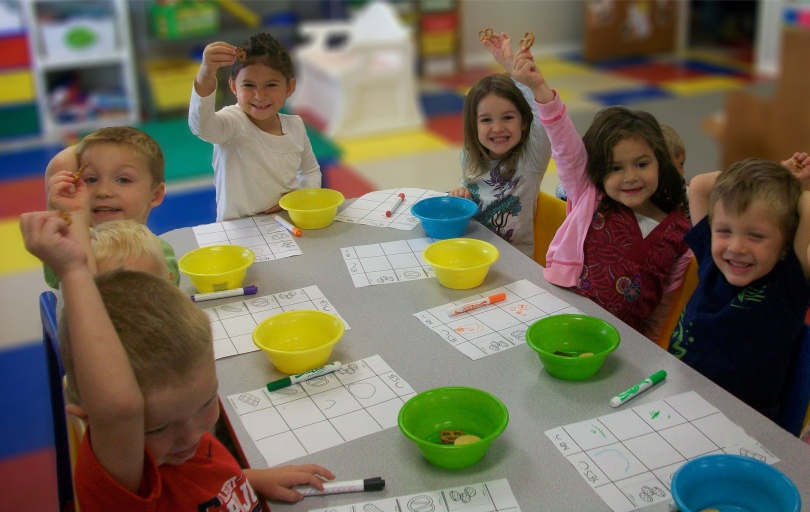
Physical: Preschool children (3 through 5 years old) are gradually refining new skills: skipping, drawing, threading, throwing and catching. They are interested in learning subtle differences through their senses: sweet and sour, rough and smooth, high and low, loud and soft. They can attend and persist for longer periods of time when they are absorbed in using their small muscles on a puzzle or an art project. They also need daily opportunities to exercise their large muscles in free play and organized activities. Daily physical activities can promote children's cognitive, creative, and language growth as well as their physical development.
Cognitive: Preschool children continue their cognitive development by actively exploring their world and manipulating objects, thinking and solving problems, talking and engaging with adults and other children in a variety of roles and repeating and practicing their learning. Their increasing ability to describe objects and experiences with words reinforces their understanding of abstract concepts. Adults can expand learning through play, introduce a variety of new opportunities for learning and ensure that preschoolers experience a balance of challenge and success.
Communication: Preschool children develop a wide range of abilities to communicate both verbally and nonverbally. Adults should communicate actively with each child — modeling good speech, listening carefully, responding actively to their expressions, engaging in conversations with them, and building on their verbal and nonverbal understanding and vocabulary. During the preschool years, early literacy experiences provide the foundation for later success in learning to read and write.
Creative: Preschool children can express their creativity in increasingly symbolic ways through the use of their bodies, words, and materials (building blocks, music, dance, art) and through make-believe. Adults can promote creativity by providing space, time, and materials for children to create and recreate their individual works, their own dramas, and their unique solutions to problems and by respecting the process of creativity as much as the product.
Resource Collection
RC II Nine learning experiences (activities), written in your own words, including one from each of the following curricular areas:
- RC II-1 Science/Sensory
- RC 11-2 Language and Literacy
- RC 11-3 Creative Arts
- RC 11-4 Fine motor (please choose an indoor activity)
- RC 11-5 Gross motor (please choose an outdoor activity)
- RC 11-6 Self Concept
- RC 11-7 Emotional Skills/ Regulation
- RC 11-8 Social Skills
- RC 11-9 Mathematics
For example, for RC II-1, Science/Sensory, you might write about an experience entitled "Smell Jars" and for RC 11-6, Self Concept, you might write about an experience entitled "Self Portraits." You may use your previous lesson plans, file folder game, activity, and reading experience as the activity for these standards.
For each experience, indicate the age group (3s, 4s or 5s) and list the intended goals, materials and processes/teaching strategies. For each activity, discuss why it is developmentally appropriate for that age group.
Competency Statements
Prepare at least one paragraph on each of the following:
CS II a Pick one of the nine learning experiences you chose for your Resource Collection (RC II). How does this experience reflect your philosophy of how to support young children's physical development?
CS II b Pick another of the nine learning experiences you chose for your Resource Collection (RC II). How does this experience reflect your philosophy of how to support young children's cognitive development?
CS II c Pick a third learning experience you chose for your Resource Collection (RC II). How does this experience reflect your philosophy of how to support young children's creative development?
CS II d In an additional paragraph, describe ways to promote the communication/ language development among all children, including dual language learners.
Cda Resource Collection Nine Learning Experiences
Source: https://waukeecdportfolio.wordpress.com/cs2/
0 Response to "Cda Resource Collection Nine Learning Experiences"
Post a Comment