In general- as you go from the Crust to the Inner Core, what happens?
Curious Kids is a serial for children of all ages, where The Conversation asks experts to answer questions from kids. All questions are welcome: find out how to enter at the bottom of this article.
What would happen if the Earth's core was no longer molten hot? – Amelia, age xiii, Devon, U.k.
Thanks Amelia, that'due south a very good question! The World'south cadre is cooling down very slowly over fourth dimension. One day, when the core has completely cooled and go solid, it will take a huge affect on the whole planet. Scientists recall that when that happens, Earth might exist a bit similar Mars, with a very thin temper and no more volcanoes or earthquakes. And then it would be very difficult for life to survive – just that won't be a problem for several billions of years.
Correct now, the World'south core is not entirely molten. The inner core is a sphere of solid iron, while the outer cadre is made of molten iron thousands of kilometres thick.
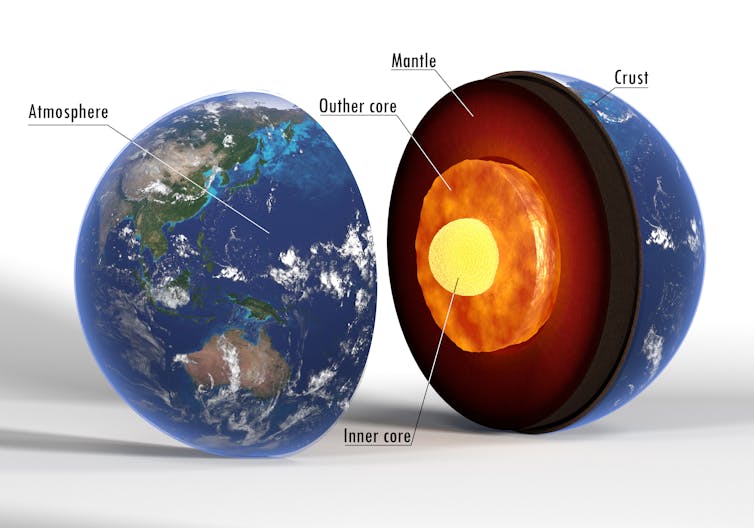
Scientists know this because the daze waves made by earthquakes can be recorded on the other side of the Earth – and we would not expect to see them there if the inner core was as well molten.
The whole core was molten back when the Earth was kickoff formed, nigh four.5 billion years ago. Since then, the Earth has gradually been cooling downwards, losing its heat to space. As information technology cooled, the solid inner core formed, and it's been growing in size e'er since.
Merely this procedure is very tedious: the inner core just grows about one millimetre a year, because the Globe has a rocky mantle in between its hot cadre and its cold surface, which stops it from cooling down as well quickly – merely similar your coat keeps you warm in winter.
The slow cooling of our planet causes the molten fe in the outer cadre to period and swirl fast equally heat is transported to the pall, and this gives Earth its magnetic field. The magnetic field is like a magnet that acts at a distance, and fifty-fifty though we cannot come across it with our eyes, it does lots of important jobs on our planet.
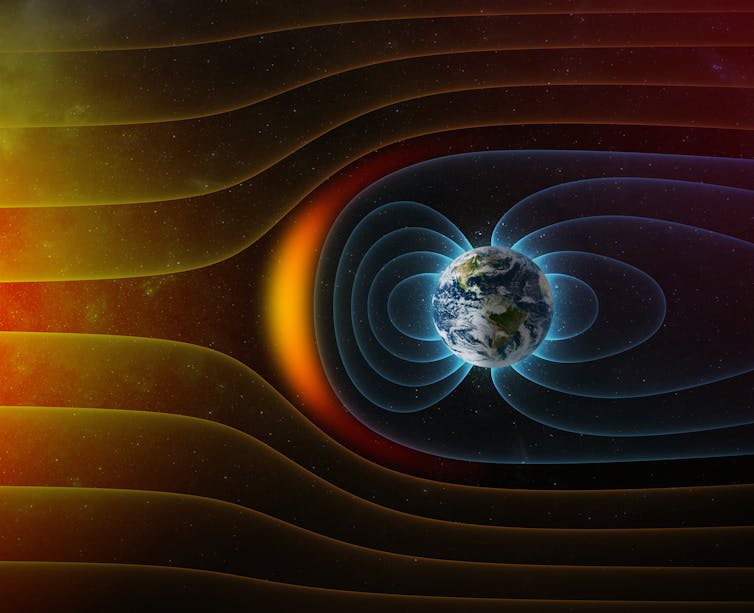
The Earth's magnetic field protects life on the Earth's surface from harmful particles coming from the sun. It also keeps the planet's atmosphere in place and helps animals to find their way around.
The heat escaping from the cadre also makes material move around in dissimilar layers of our planet – from the rocky curtain to the rigid plates on the surface, where you and I live.
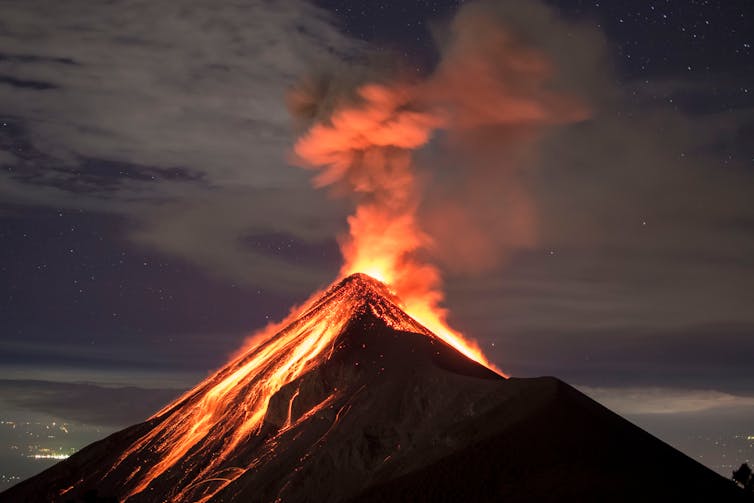
This move can cause the plates on the surface to rub together, which creates earthquakes and volcanoes. That's why living in places where 2 plates meet – such as Nepal or Japan – can be very dangerous.
When the molten outer cadre cools and becomes solid, a very long time in the time to come, the World'south magnetic field volition disappear.
When that happens, compasses volition finish pointing n, birds will not know where to fly when they migrate, and the World's temper will disappear. This will make life on Earth very difficult for man beings and other life forms.
When the Earth has cooled completely, the movement in the mantle will also stop eventually. Then, the plates on the surface will no longer move and there volition exist fewer earthquakes and volcanic eruptions.
Y'all might think that this would be good for people – especially those living in places similar Tokyo – but volcanic eruptions also produce fertile soil for farming, and gases that make up the air that we breathe.
Afterward all this, Globe could look a bit similar Mars. On the surface of Mars, scientists have seen features that are related to volcanoes and moving plates. Only they are not moving any more, and at that place is no magnetic field and only a thin atmosphere left.
We exercise non know whether the core of Mars is still molten or not, but a robot called InSight recently landed on Mars that will help us to notice out!
But for now, you lot don't have to worry about the Earth's core losing all its rut and becoming solid, because the curtain is wrapped effectually the core, keeping it overnice and warm.
Hello, curious kids! Accept you got a question you'd like an expert to answer? Ask an developed to transport your question to us. Y'all can:
* Email your question to curiouskids@theconversation.com
* Tell united states on Twitter by tagging @ConversationUK with the hashtag #curiouskids, or
* Message us on Facebook.

Please tell us your proper name, age and which town or city yous live in. You lot can transport an audio recording of your question too, if you want. Send as many questions as you like! We won't be able to answer every question, but we will practise our best.
More Curious Kids articles, written by academic experts:
-
What existed before the Big Blindside? – Ethan, historic period x, Sydney, Australia
-
What is a species? – Finlay, age 4, London, UK
-
How practise moths eat our wearing apparel? – Albie, age five, Australia
Source: https://theconversation.com/curious-kids-what-would-happen-if-the-earths-core-went-cold-107537
0 Response to "In general- as you go from the Crust to the Inner Core, what happens?"
Post a Comment