What were the Americans trying to capture on Iwo Jima
| Battle of Iwo Jima | |||||||
|---|---|---|---|---|---|---|---|
| Part of Globe War II, Pacific State of war | |||||||
 A U.S. 37 mm (ane.five in) gun fires against Japanese cave positions in the north face up of Mount Suribachi | |||||||
| |||||||
| Belligerents | |||||||
 United States United States |  Empire of Japan Empire of Japan | ||||||
| Commanders and leaders | |||||||
| Holland Smith Marc Mitscher | Tadamichi Kuribayashi † | ||||||
| Strength | |||||||
| 70,000 | eighteen,061–eighteen,591[ane] | ||||||
| Casualties and losses | |||||||
| 12,822 killed/missing[two] xix,217 wounded[one] | 17,845–xviii,375 killed/missing[one] 216 captured[1] | ||||||
The Boxing of Iwo Jima was the American capture of the Japanese island of Iwo Jima during the Pacific Campaign of World War Two. The United states of america needed to capture Iwo Jima to be able to defeat Nihon. Many films were made virtually information technology, for case Flags of our Fathers and Messages from Iwo Jima, that were both directed past Clint Eastwood.
It lasted from 19 February – 26 March 1945. It was a major battle in which the United States Military machine captured the island of Iwo Jima from the Japanese Empire.
The Americans wanted to capture the island, including its iii airfields, and employ this area for attacks on the Japanese main islands.[2] This five-week boxing had violent fighting.
After suffering such heavy losses, people questioned why the US went into the battle. The isle was not useful for the Navy or Air Force.[iii]
The Purple Japanese Army had thick defenses and secret tunnels for embrace.[4] [v] The Americans had ships that could burn on the island and full control of the air.[6] This invasion was the first American attack on Japanese home territory.
The Japanese general, Tadamichi Kuribayashi, and his soldiers refused to surrender. He and his officers said they would fight until they died.
At that place were 22,000 Japanese soldiers on Iwo Jima at the beginning of the battle, and only 216 were taken prisoner at the end.[1]
Well-nigh 3,000 Japanese soldiers kept fighting for weeks.[1] [7]
With no retreat and no possibility of reinforcements, the Japanese had dug in and prepared to fight until they died. This meant that winning the battle, meant the Americans would have to destroy the entire Japanese force stationed on the isle.[viii]
The battle was made famous by Joe Rosenthal's photograph of the raising of the U.S. flag on tiptop of the 166 yard (545 ft) Mount Suribachi.
This photograph became an important image of this boxing, of the war in the Pacific, and of the Marine Corps.[9]
Background [change | change source]

After the Americans captured the Marshall Islands in January 1944, the Japanese military leaders thought about their state of affairs.
It looked similar the Americans would go toward the Mariana Islands and the Carolines. The Imperial Japanese Army and the Imperial Japanese Navy (I.J.North.) set up a line of defences.
In March 1945, the Japanese 31st Army, allowable by General Hideyoshi Obata, was ordered to defend this line.
The commander of the Japanese group on Chichi Jima was placed in command of Ground forces and Navy units in the Volcano Islands.[2] The Americans had started bombing Japan every twenty-four hour period after they captured the Marianas. The Japanese were using Iwo Jima to transmit radio reports of American bomber action.[2]
After the U.S. captured bases in the Marshalls in February 1944, Japanese Ground forces and Navy troops were sent to Iwo Jima. Iwo Jima had more than 5,000 men.[two]
The loss of the Marianas during the summer of 1944 made the Japanese worried about the Volcano Islands. They knew that the Americans could launch airattacks on Nihon if these islands were captured.[ii] However, it was hard for Nippon to defend the Volcano Islands because the Imperial Japanese Navy had lost most all of its ships.
Japan could not build new airplanes until March or Apr 1945. Fifty-fifty then, these planes could non fly to Iwo Jima from Japan. Nippon did mot take enough pilots and other aircrew.
Iwo Jima was important for two reasons: it was an air base for Japanese fighter planes, and information technology was a safe place for Japanese ships. In add-on, it was used by the Japanese to do air attacks on the Mariana Islands.
Capturing Iwo Jima would deny the air base from the Japanese and provide a place from which to launch the invasion of Japan.
When the The states decided to invade Iwo Jima, experts thought it would exist captured in one week, but hundreds of tons of Allied bombs had not harmed the entrenched Japanese defenders.
Planning and training [change | change source]
Japanese preparations [change | change source]
By June 1944, Lieutenant General Tadamichi Kuribayashi was ordered to defend Iwo Jima. He knew that Japan could not win the battle, but hoped to inflict enough casualties to dissuade the Allies from invading Japan.
Kuribayashi created strong defences with heavy weapons such as heavy machine guns and artillery. Extensive tunnels were dug, and Land mines were placed all over the isle.
The amphibious landing [modify | alter source]
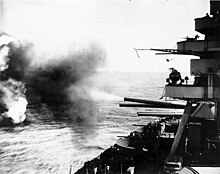
The battleship USSNew York firing its 356 mm (14.0 in) master guns on the island, xvi February 1945
Starting on 15 June 1944, the U.S. Navy and the U.S. Army Air Forces began to assault the isle. Naval artillery shellings and air bombings were done for ix months. Each heavy warship fired for approximately vi hours.
These efforts failed to achieve desired effects due to the Japanese defenses. The American bombings continued until nineteen Feb 1945: the mean solar day the Marines landed on the island.
About 450 American ships were near Iwo Jima. The battle involved well-nigh 60,000 U.Southward. Marines.[10]
At 08:59, xxx,000 Marines began landing on the isle. The Japanese held their fire for some time while men and material began to fill the beaches. So the Japanese opened fire, and many in the starting time group of Marines were killed by the machine guns.[11]
Japanese heavy artillery was protected by steel doors that closed to protect the guns between shots. This fabricated it hard for American units to destroy Japanese artillery.[11] The Japanese soldiers hid in the tunnel system.
With tanks, naval artillery, and air bombing on Mountain Suribachi, the Marines were able to get past the beaches.[11] About forty,000 more Marines landed later.[11]
The fighting on Iwo Jima was very violent. The Marines' advance was stopped by defensive positions and artillery. The Marines used flamethrowers and grenades to kill Japanese troops in the tunnels.
Eight Sherman M4A3R3 medium tanks with a flamethrower destroyed Japanese defences. The Japanese ran out of h2o, food, and supplies. The Japanese made more dark attacks. Nearly Japanese soldiers fought to the death.[11]
Raising the flag [change | change source]

U.S. postage stamp stamp, 1945 issue, commemorating the Battle of Iwo Jima
"Raising the Flag on Iwo Jima" is a photograph taken on 23 February 1945 by Joe Rosenthal. It shows five Marines and a U.South. Navy corpsman raising the flag of the United states on Mount Suribachi.[9] The photograph was popular. It won a Pulitzer Prize for Photography.[nine]
The Japanese troops stayed in the tunnels . They were all killed.[11]
Northern Iwo Jima [change | change source]

The Japanese even so held positions on the northward end.[12] Kuribayashi had eight infantry battalions, a tank regiment, two artillery battalions, and 3 heavy mortar battalions. He also had almost 5,000 gunners and naval infantry.
The Marines' tanks were destroyed past Japanese fire and mines.[thirteen] Many Americans were killed or wounded.
The Marines attacked in the darkness with no bombing earlier the attack. Many Japanese soldiers were killed while nevertheless sleeping.[fourteen]
On the evening of 8 March, Captain Samaji Inouye and his one,000 men attacked the Americans causing 347 casualties (90 deaths). The Marines counted 784 dead Japanese soldiers the side by side day.[15]
There was also a kamikaze air attack on the ships anchored at sea on 21 February. This sunk the escort carrier USSBismarck Sea and severely damaged the USSSaratoga. There was minor impairment to the escort carrier USSLunga Betoken, an LST, and a transport.[14]
On xvi March, Kuribayashi'south soldiers were still live on the northwestern end of the island. On 21 March, the Marines blew up the Japanese with four tons of explosives. On 24 March, Marines sealed upwards the caves.[16]
A 300-man Japanese force attacked Airfield No. two. There was a 90-minute fight and information technology suffered heavy casualties (53 killed, 120 wounded). The island was finally captured at 09:00 on 26 March.
Weapons [change | alter source]
In the Pacific the United states used the M2 flamethrower.[17] These flamethrowers were used to kill Japanese in caves. Marines also had flamethrowers on tanks which were used during boxing. They were less useful because of Iwo Jima'southward rough land. Many other infantry weapons were utilized, including the infamous M1 Garand.
Aftermath [change | alter source]

U.Due south. Marines pose on top of enemy pillbox with a captured Japanese flag
Of the 22,060 Japanese soldiers on the island, 18,844 died from fighting or by suicide. Only 216 were captured during the battle. Subsequently Iwo Jima, 3,000 hid in the tunnels.
The 36-mean solar day boxing for Iwo Jima resulted in more than 26,000 American casualties, including 6,800 dead.[xviii] By comparison, the 82-day battle for Okinawa resulted in casualties of over 62,000, of whom over 12,000 were killed or missing. Iwo Jima was besides the only U.S. Marine battle where the Americans suffered more casualties than the Japanese.[19]
Because they had all been removed, at that place were no civilian casualties at Iwo Jima, unlike at Saipan and Okinawa.[20]
Strategic importance [alter | change source]

American supplies beingness landed at Iwo Jima
Given the number of casualties, the importance of the island'southward capture[21] is controversial.
Iwo Jima was not used past the U.s.a. Army Air Corp to drop the atomic bombs on Japan. Tinian was the Island both bombers left to flop Hiroshima and Nagasaki, which were 12 hours out and back.
The argument for capturing Iwo Jima was that it provided a landing and refueling airfield for fighter escorts. Yet, only 10 missions were ever flown from Iwo Jima.[22]
Japanese fighter aircraft based on Iwo Jima sometimes attacked the The states forces. Only 11 B-29s were lost.[23]
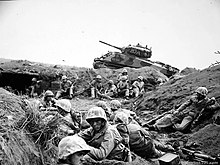
Marines from the 24th Marine Regiment during the Battle of Iwo Jima
The Japanese on Iwo Jima had radar[24] and could notify Japanese forces at habitation of B-29 Superfortresses flight from the Mariana Islands.
However, the capture of Iwo Jima did not affect the Japanese radar system.[25]
Legacy [change | modify source]
The United states of america Navy has several ships of the name USSIwo Jima.
On 19 February 1985, the 40th ceremony of the landings, an event chosen the Reunion of Award was held.[26] The veterans of both sides who fought in the battle of Iwo Jima attended the event. A memorial was built. Representatives of both countries shook hands.
The importance of the battle to Marines today can be seen. Marines become to the isle and to the summit of Suribachi.[27]
The Japanese authorities continues to search for the bodies of Japanese armed services troops who were killed during the boxing.[28]
Medal of Laurels awards [change | modify source]
The Medal of Honor is the highest military ornament awarded by the United States government. It is given to a member of the U.s. military who evidence bravery and risks his life in a battle. The medal is oftentimes awarded after death. Information technology has been given only 3,464 times.
During this one-month-long boxing, 27 U.S. military personnel were given the Medal of Laurels for their deportment, 14 of them after decease.
Movies and documentaries [change | change source]
- To the Shores of Iwo Jima, a 1945 American documentary produced by the Us Navy, Marine Corps and the Coast Guard.
- Glamour Gal, a 1945 movie most Marine arms.
- Sands of Iwo Jima, a 1949 American moving-picture show starring John Wayne.
- The Outsider, a 1961 picture show starring Tony Curtis equally the conflicted flag raiser Ira Hayes.[29]
- Flags of Our Fathers and Letters from Iwo Jima are two 2006 films directed by Clint Eastwood. Flags of Our Fathers is filmed from the American perspective and is based on the book past James Bradley and Ron Powers (Flags of Our Fathers). Letters from Iwo Jima (originally titled Red Sun, Black Sand) is filmed from the Japanese perspective.
- Function 8 of the 2010 HBO miniseries The Pacific, produced by Tom Hanks and Steven Spielberg, includes part of the battle of Iwo Jima from the indicate of view of a Marine who died in that location.
- Episode 23 from the 1973 Thames Telly Documentary The World at War.
- Battle Rats: Iwo Jima (2009) (TV).
- The movie "The League of Grateful Sons" by Vision Forum concerns the Battle of Iwo Jima
Notes [change | change source]
- ↑ ane.0 i.1 1.2 ane.3 one.4 i.5 Burrell 2006, p. 83. Burrell talks about how many historians accept overestimated the number Japanese defenders, with 20,000 and even 25,000 listed. Burrell puts the range between 18,060 and 18,600, with exactly 216 of these taken prisoner. The rest were killed in action.
- ↑ 2.0 2.1 2.two 2.3 ii.4 2.5 Morison, Samuel Eliot (2002) [1960]. Victory in the Pacific, 1945. Volume fourteen of History of U.s. Naval Operations in World War Two. Urbana, IL: University of Illinois Printing. ISBN0-252-07065-8. OCLC 49784806.
- ↑ Pratt, William 5. (2 April 1945). "What Makes Iwo Jima Worth the Price". Newsweek. p. 36.
- ↑ "Letters from Iwo Jima". World War II Multimedia Database. Archived from the original on 2007-12-12. Retrieved 2013-12-08 .
- ↑ "Battle of Iwo Jima—Japanese Defense force". Earth War II Naval Strategy.
- ↑ Video: Carriers Hit Tokyo! 1945/03/19 (1945). Universal Newsreel. 1945. Retrieved 22 Feb 2012.
- ↑ John Toland, Ascent Dominicus - The Decline and Autumn of the Japanese Empire 1936-1945, page 669
- ↑ Adrian R. Lewis, The American Civilisation of War. The History of U.S. Military machine Forcefulness from Globe War II to Operation Iraqi Freedom, New York 2007, p. 59
- ↑ 9.0 nine.one 9.2 Landsberg, Mitchell (1995). "Fifty Years Later, Iwo Jima Photographer Fights His Ain Battle". Associated Printing. Archived from the original on v September 2007. Retrieved eleven September 2007.
- ↑ "United States Marine Corps War Memorial". The George Washington University. Archived from the original on 29 June 2011. Retrieved 28 February 2011.
- ↑ 11.0 11.1 xi.2 11.3 11.4 11.5 Allen, Robert Eastward. (2004). The Beginning Battalion of the 28th Marines on Iwo Jima: A Day-by-Day History from Personal Accounts and Official Reports, with Complete Muster Rolls. Jefferson, N.C.: McFarland & Company. ISBN0-7864-0560-0. OCLC 41157682.
- ↑ Keith Wheeler, THE ROAD TO TOKYO, Time-Life Books, 1979, Alexandria, Virginia, p.50
- ↑ Robert Leckie, DELIVERED FROM EVIL, Harper & Row, 1987, New York, p870
- ↑ 14.0 14.ane Robert Leckie, p.872
- ↑ Keith Wheeler
- ↑ Moskin, pp.372–373
- ↑ "Flamethrower". Archived from the original on 28 June 2011. Retrieved 28 February 2011.
- ↑ "Battle for Iwo Jima, 1945". The Navy Department Library. 16 January 2008. Archived from the original on vi December 2006. Retrieved 3 Dec 2013.
- ↑ O'Brien, Cyril J. "Iwo Jima Retrospective". Archived from the original on 7 June 2007. Retrieved 21 June 2007.
- ↑ "Selected March Dates of Marine Corps Historical Significance". History Sectionalization, United States Marine Corps. Archived from the original on 28 Nov 2010. Retrieved 11 September 2007.
- ↑ "The Boxing of Iwo Jima". History Department at the University of San Diego. Archived from the original on 20 July 2009. Retrieved x March 2010.
- ↑ Assistant Main of Air Staff (September–October 1945). "Iwo, B-29 Haven and Fighter Springboard". Affect. pp. 69–71.
- ↑ Craven, Wesley Frank; James Lea Cate (1953). The Army Air Forces in World War 2. Chicago: University of Chicago Press. pp. 5:581–82. ISBN0-226-11995-5. OCLC 704158.
- ↑ Newcomb, Richard F. (2002). Iwo Jima. Holt Paperbacks. p. 59. ISBN0-8050-7071-0.
- ↑ Joint War Planning Committee 306/1, "Programme for the Seizure of Rota Island," 25 Jan 1945.
- ↑ Marling, Karal Ann; & Wetenhall, John (1991). "Iwo Jima: Monuments, Memories, and the American Hero" (PDF). Harvard University Printing. Cambridge, Massachusetts. Retrieved April half-dozen, 2016.
{{cite news}}: CS1 maint: multiple names: authors list (link) - ↑ Blumenstein, LCpl Richard; Sgt. Ethan E. Rocke (October–December 2007). "From Blackness Sands to Suribachi'southward Summit: Marines Reflect on Historic Boxing". Marines Magazine. United States Marine Corps. Archived from the original on 11 Feb 2009. Retrieved 18 December 2008.
- ↑ Kyodo News, "Map of Iwojima's underground bunkers constitute in U.S.", Nihon Times, 6 May 2012, p. 2.
- ↑ "Outsider (1961)". imdb. Retrieved 2 January 2008.
References [change | change source]
- Allen, Robert E. (2004). The Showtime Battalion of the 28th Marines on Iwo Jima: A Day-by-Day History from Personal Accounts and Official Reports, with Complete Muster Rolls. Jefferson, N.C.: McFarland & Company. ISBN0-7864-0560-0. OCLC 41157682.
- Bradley, James; Ron Powers (2001) [2000]. Flags of Our Fathers. New York: Bantam. ISBN0-553-38029-X. OCLC 48215748.
- Bradley, James (2003). Flyboys: A True Story of Courage. Boston: Footling, Brown and Visitor. ISBN0-316-10584-8. OCLC 52071383.
- Buell, Hal (2006). Uncommon Valor, Common Virtue: Iwo Jima and the Photo that Captured America. New York: Penguin Group. ISBN0-425-20980-6. OCLC 65978720.
- Burrell, Robert Due south. "Breaking the Cycle of Iwo Jima Mythology: A Strategic Study of Functioning Detachment," Journal of Armed services History Book 68, Number 4, October 2004, pp. 1143–1186 and rebuttal in Project MUSE
- Burrell, Robert S. (2006). The Ghosts of Iwo Jima. College Station: Texas A&Yard University Printing. ISBNane-58544-483-9. OCLC 61499920.
- Eldridge, Robert D.; Charles W. Tatum (2011). Fighting Spirit: The Memoirs of Major Yoshitaka Horie and the Battle of Iwo Jima. Annapolis: Naval Plant Press. ISBN978-1-59114-856-2.
- Hammel, Eric (2006). Iwo Jima: Portrait of a Battle: U.s. Marines at State of war in the Pacific. St. Paul, Minn.: Zenith Press. ISBN0-7603-2520-0. OCLC 69104268.
- Hearn, Chester (2003). Sorties into @#!*% : The Hidden War on Chichi Jima. Westport, Conn.: Praeger Publishers. ISBN0-275-98081-ii. OCLC 51968985.
- Kakehashi, Kumiko (2007). Then Lamentable to Fall in Battle: An Account of War Based on General Tadamichi Kuribayashi'due south Letters from Iwo Jima. Presidio Press. ISBN978-0-89141-917-4.
- Kirby, Lawrence F. (1995). Stories From The Pacific: The Island State of war 1942–1945. Manchester, Mass.: The Masconomo Press. ISBN0-9645103-ane-6. OCLC 32971472.
- Leckie, Robert (2005) [1967]. The Boxing for Iwo Jima. New York: ibooks, Inc. ISBNi-59019-241-9. OCLC 56015751.
- Linenthal, Edward T. "Shaping a Heroic Presence: Iwo Jima in American Retentiveness," Reviews in American History Vol. 21, No. 1 (March 1993), pp. 8–12 in JSTOR
- Lucas, Jack; D.K. Pulsate (2006). Indestructible: The Unforgettable Story of a Marine Hero at the Battle of Iwo Jima. Cambridge, Mass.: Da Capo Press. ISBN0-306-81470-half dozen. OCLC 68175700.
- Morison, Samuel Eliot (2002) [1970]. Victory in the Pacific, 1945, vol. 14 of History of United states Naval Operations in Earth War II. Urbana, Ill.: University of Illinois Press. ISBN0-252-07065-8. OCLC 49784806.
- Newcomb, Richard F.; Harry Schmidt (2002) [1965]. Iwo Jima. New York: Owl Books. ISBN0-8050-7071-0. OCLC 48951047.
- Overton, Richard Eastward. (2006). God Isn't Hither: A Young American's Entry into World War II and His Participation in the Battle for Iwo Jima. Clearfield, Utah: American Legacy Media. ISBN0-9761547-0-6. OCLC 60694955.
- Ross, Bill D. (1986) [1985]. Iwo Jima: Legacy of Valor. New York: Vintage. ISBN0-394-74288-5. OCLC 13582622.
- Shively, John C. (2006). The Concluding Lieutenant: A Foxhole View of the Ballsy Battle for Iwo Jima. Bloomington: Indiana University Press. ISBN0-253-34728-ix. OCLC 61761637.
- Toyn, Gary W. (2006). The Serenity Hero: The Untold Medal of Honour Story of George E. Wahlen at the Battle for Iwo Jima. Clearfield, Utah: American Legacy Media. ISBN0-9761547-1-4. OCLC 72161745.
- Veronee, Marvin D. (2001). A portfolio of photographs: selected to illustrate the setting for my experience in the boxing of Iwo Jima, World War 2, Pacific theater. Quantico: Visionary Pub. ISBN0-9715928-2-9. OCLC 52001277.
- Wells, John K. (1995). Give Me Fifty Marines Not Afraid to Die: Iwo Jima. Abilene, Tex.: Quality Publications. ISBN0-9644675-0-Ten. OCLC 32153036.
- Wheeler, Richard (1994) [1980]. Iwo. Annapolis, Dr..: Naval Institute Press. ISBNane-55750-922-0. OCLC 31693687.
- Wheeler, Richard (1994) [1965]. The @#!*% Battle for Suribachi. Annapolis, Md.: Naval Establish Press. ISBNone-55750-923-ix. OCLC 31970164.
- Wright, Derrick (2007) [1999]. The Battle of Iwo Jima 1945. Stroud: Sutton Publishing. ISBN978-0-7509-4544-eight. OCLC 67871973.
- Kindersley, Dorling; World War Ii: The Definitive Visual History; DK publishing; 2009
Online [change | change source]
- Alexander, Col. Joseph H., USMC (Ret). (1994). Closing In: Marines in the Seizure of Iwo Jima. Marines in World State of war II Commemorative Series. Washington, D.C.: History and Museums Segmentation, Headquarters, United States Marine Corps. OCLC 32194668.
{{cite book}}: CS1 maint: multiple names: authors list (link) - Bartley, LtCol. Whitman S., USMC (1954). Iwo Jima: Amphibious Epic. Marines in World War II Historical Monograph. Washington, D.C.: Historical, Sectionalization of Public Data, Headquarters, Us Marine Corps. OCLC 28592680.
{{cite volume}}: CS1 maint: multiple names: authors list (link) - Garand, George W.; Truman R. Strobridge (1971). "Part VI: Iwo Jima". Western Pacific Operations. Volume IV of History of U.Due south. Marine Corps Operations in World War II. Historical Branch, The states Marine Corps. ISBN0-89839-198-nine.
- Dyer, George Carroll (1956). "The Amphibians Came to Conquer: The Story of Admiral Richmond Kelly Turner". United States Regime Printing Function. Archived from the original on 21 May 2011. Retrieved 5 May 2011.
- "Blithe Map History of The Battle of Iwo Jima (including Medal of Honor citations)". HistoryAnimated.com. Archived from the original on 2007-10-22. Retrieved 2013-12-08 .
- "The Battle for Iwo Jima (color gainsay footage)". SonicBomb.com. [ permanent dead link ]
- Brady, John H. "Iwo Jima". Iwo Jima, Inc. Archived from the original on 2006-01-02. Retrieved 2013-12-03 .
- "Boxing of Iwo Jima". WW2DB.com. – Site contains 250 photographs.
- Williams, Greg. "Dimensions of Valor". Tampa Tribune. TBO.com. Archived from the original (Wink) on 2006-12-05. Retrieved 2013-12-08 . – 3-D Stereo Photograph of Iwo Jima Flag-raising.
- "Mt. Suribachi HDR Image". Japan Photos. February 2007. [ permanent expressionless link ] – A tone-mapped High Dynamic Range Image of Iwo Jima.
- "Iwo Jima: Forgotten Valor". Chief Source Adventures. Portal to Texas History, University of North Texas.
- Dawson, Rick (2007). "The Battle of Iwo Jima". ArticleMyriad.com. Archived from the original on 2007-02-26. Retrieved 2013-12-03 .
- "Iwo Jima Combat Footage in Color". WW2incolor.com. Archived from the original on 2007-06-01. Retrieved 2013-12-08 .
- Lemer, Jeremy (15 February 2005). "Remembering the Battle of Iwo Jima". Columbia News Service. Archived from the original on 8 September 2006. Retrieved 6 October 2006.
- "Operations map of Iwo Jima" (JPG). 23 October 1944.
- "Collection of military maps of Iwo Jima". Historical Resources. 15 September 2008. Archived from the original on 8 Jan 2009. Retrieved 15 January 2021.
- "To the Shores of Iwo Jima" (Video). Google Video.
- "Battle of Iwo Jima". History of War.
- Alexander, Colonel Joseph (2000). "Battle of Iwo Jima". HistoryNet.com and World War II magazine. Archived from the original on 2011-06-11. Retrieved 2013-12-03 .
- "Iwo Jima Pictures". WW2-Pictures.com. Archived from the original on 2010-04-16. Retrieved 2013-12-03 .
- "Victory At Body of water: Target Suribachi" (Video). Internet Annal. Archived from the original on 12 February 2009. Retrieved 17 Jan 2009.
- "Rare photos of the Boxing of Iwo Jima from the U.S. National Archives and the Department of Defense, USMC". Awesome Stories. Retrieved ix March 2010.
- "Daily summaries of fighting, Medal of Honor citations, a listing of those who died on Iwo Jima, and maps of the battle". Iwojimahistory.com. Retrieved 8 November 2011.
Other websites [change | alter source]
-
 Media related to Battle of Iwo Jima at Wikimedia Commons
Source: https://simple.wikipedia.org/wiki/Battle_of_Iwo_Jima
0 Response to "What were the Americans trying to capture on Iwo Jima"
Post a Comment